ALPS Conference 2026

Research Posters

Meet the researchers presenting their work in psychedelic science at the conference, 9–10 October 2026 in Aarau. Find them by their research posters during the breaks, or read them in full here.

Guidelines for presenters
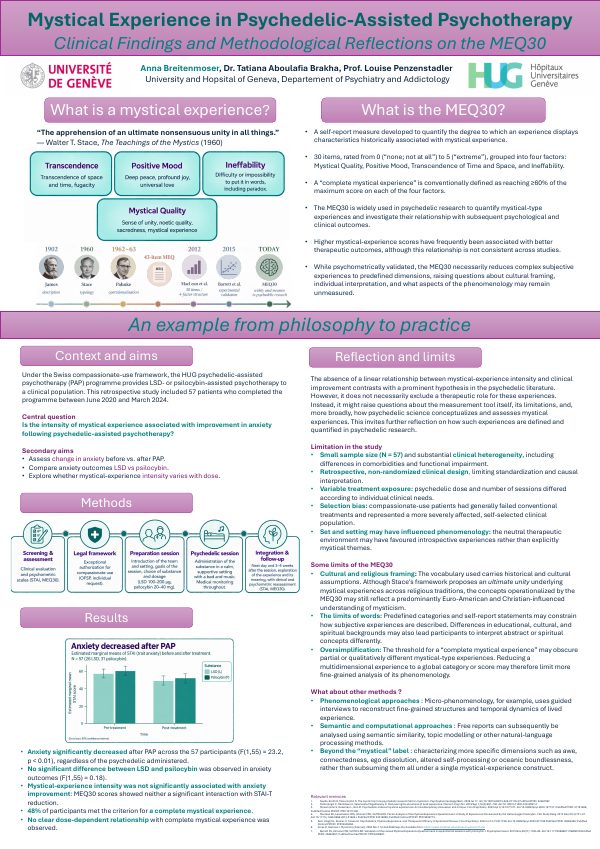
First page of the research poster “Mystical Experience in Psychedelic-Assisted Psychotherapy: Clinical Findings and Methodological Reflections on the MEQ30”

Mystical Experience in Psychedelic-Assisted Psychotherapy: Clinical Findings and Methodological Reflections on the MEQ30
Anna Breitenmoser

Anna Breitenmoser

MSc · Student

University and Hospital of Geneva, Switzerland

Mystical experiences are altered states of consciousness characterized by a profound sense of unity, transcendence of time and space, ineffability, and deeply felt noetic or sacred qualities. Historically associated with spiritual and religious traditions, these experiences have become a growing subject of scientific investigation within contemporary psychedelic research. In psychedelic-assisted psychotherapy (PAP), mystical-type experiences are frequently proposed as key mediators of therapeutic improvement and are commonly assessed using the Mystical Experience Questionnaire (MEQ30). However, the phenomenology, historical foundations, and methodological limitations of this construct remain insufficiently discussed.
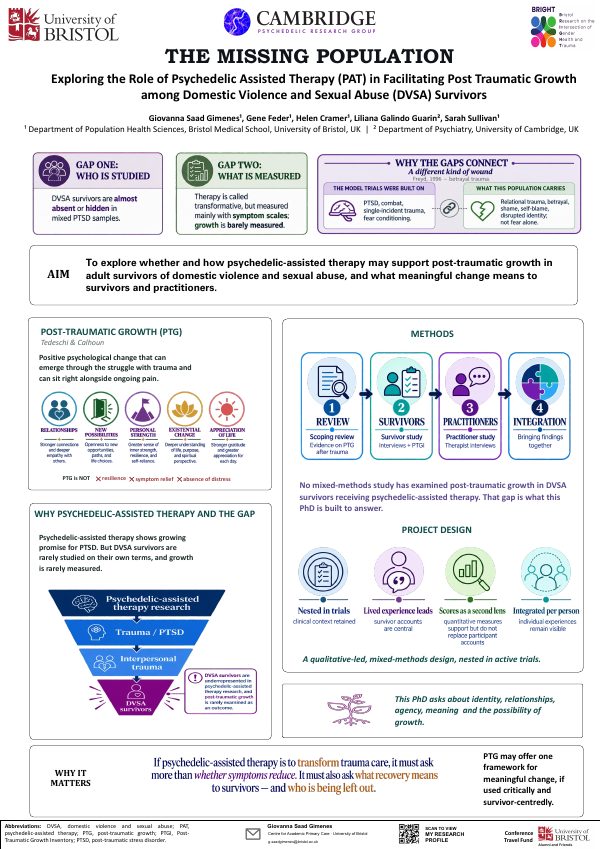

First page of the research poster “The Missing Population: Post-Traumatic Growth in Domestic Violence and Sexual Abuse Survivors Receiving Psychedelic/Psychoactive-Assisted Therapy”

The Missing Population: Post-Traumatic Growth in Domestic Violence and Sexual Abuse Survivors Receiving Psychedelic/Psychoactive-Assisted Therapy

Giovanna Saad Gimenes

Giovanna Saad Gimenes

MA, PhD candidate · PhD researcher, part-time psychotherapist

University of Bristol, UK

Background. Survivors of domestic violence (DV) and sexual abuse (SA) form one of the largest trauma populations worldwide, yet are largely absent from psychedelic/psychoactive-assisted therapy trials; where present, they are typically subsumed within heterogeneous PTSD samples. DV and SA produce a distinctive, interpersonal trauma organised around betrayal, shame and disrupted identity — features that symptom-reduction frameworks capture poorly. Post-traumatic growth (PTG), the positive psychological change that can emerge through the struggle with trauma, is rarely measured or treated as a legitimate therapeutic target in this field.

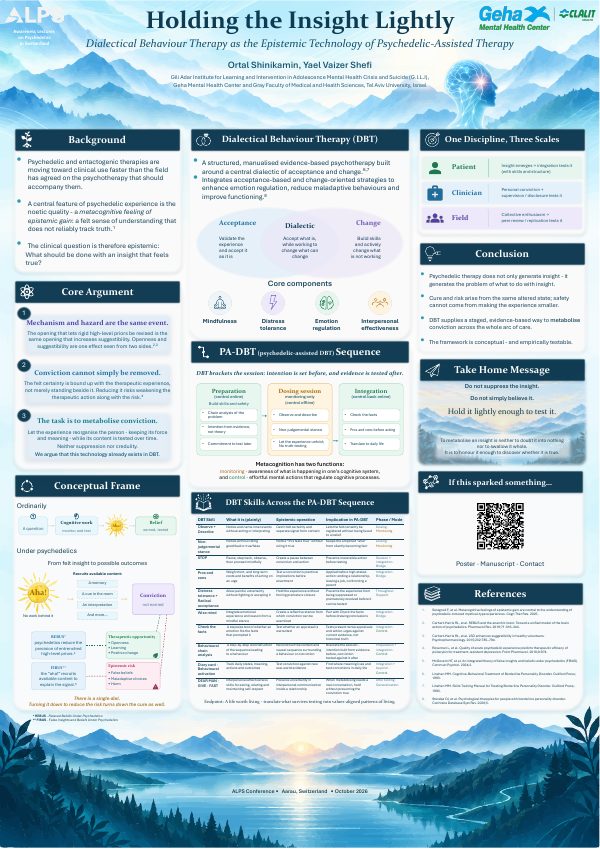
First page of the research poster “Holding the Insight Lightly: An Epistemic Framework for Psychedelic-Assisted Therapy, Built from Dialectical Behaviour Therapy”

Holding the Insight Lightly: An Epistemic Framework for Psychedelic-Assisted Therapy, Built from Dialectical Behaviour Therapy

Ortal Shinikamin

Ortal Shinikamin

MD-PhD candidate · Incoming psychiatry resident

Gray Faculty of Medical and Health Sciences, Tel Aviv University, Israel

Psychedelic experiences can produce insights that arrive with complete conviction - felt not as conclusions reached, but as truths already known. This noetic certainty can be understood as a metacognitive feeling of epistemic gain: a felt signal that understanding has occurred even when the cognitive work that would ordinarily warrant it has not, leaving the mind to draw on available memories, interpretations and contextual cues to explain a certainty already felt. This conceptual work argues that the therapeutic mechanism and the central epistemic hazard are one event: the same felt certainty that appears to carry therapeutic change can also confer epistemic authority on convictions before that authority has been earned. Therapeutic benefit and epistemic hazard therefore cannot simply be tuned apart.

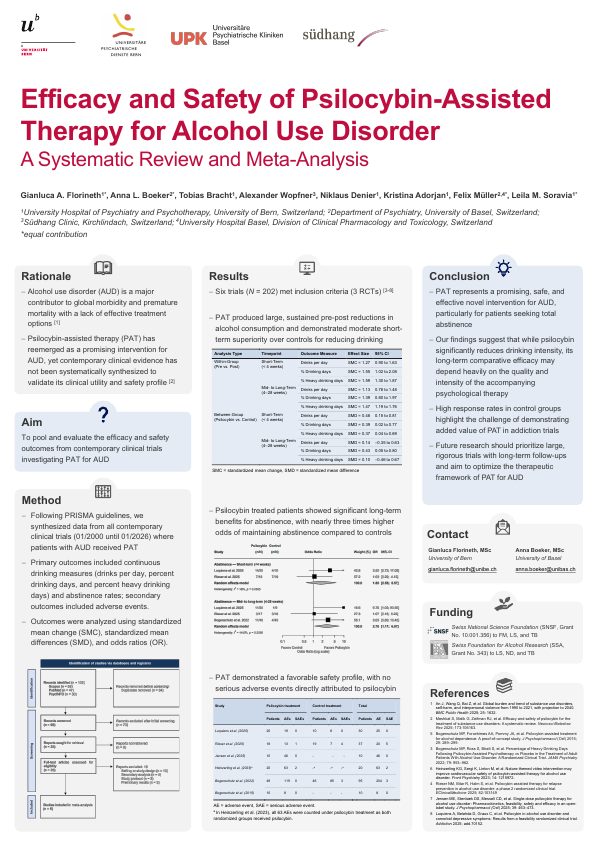
First page of the research poster “Efficacy and Safety of Psilocybin-Assisted Therapy for Alcohol Use Disorder”

Efficacy and Safety of Psilocybin-Assisted Therapy for Alcohol Use Disorder

Anna L. Boeker

Anna L. Boeker

MSc · PhD student in clinical research

University of Basel and University Psychiatric Clinic Basel (UPK), Switzerland

Our clinical research group for substance-assisted therapy at the UPK Basel includes professionals from the fields of psychiatry, psychology, and clinical research. The main focus of our work is research on the effects of LSD, which we have been studying since 2014 in several studies. We examine efficacy, safety and possible positive long-term effects of LSD in mental health conditions such as anxiety and depression. In the LYTA trial, together with the University of Bern, we will investigate LSD assisted therapy for alcohol use disorder in a multicenter, double-blind, randomized, active-placebo controlled phase II neuroimaging trial with a consecutive open-label phase.

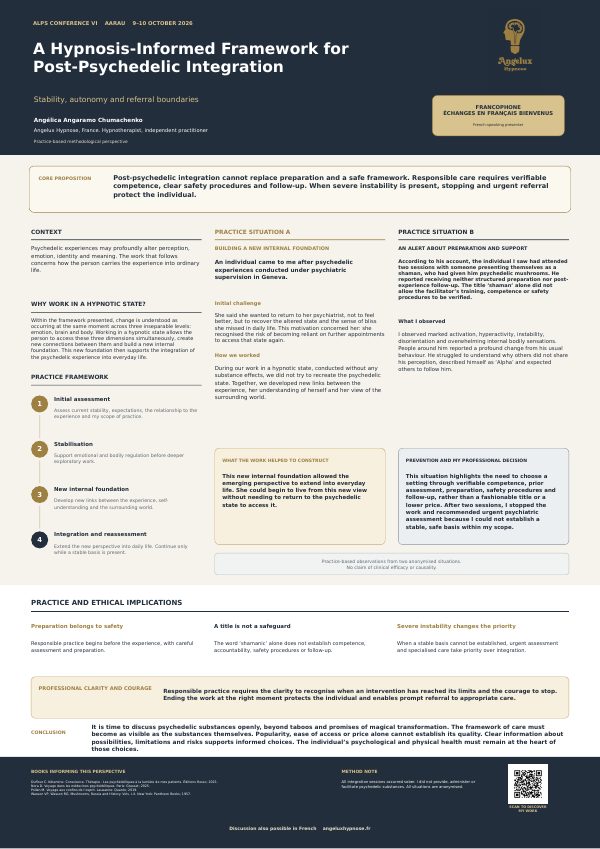
First page of the research poster “A Hypnosis-Informed Framework for Post-Psychedelic Integration: Stability, Autonomy and Referral Boundaries”

A Hypnosis-Informed Framework for Post-Psychedelic Integration: Stability, Autonomy and Referral Boundaries

Angélica Angaramo Chumachenko

Angélica Angaramo Chumachenko

Hypnotherapist, independent practitioner

Angelux Hypnose, France

Drawing on two anonymised situations from my independent practice, this poster explores hypnosis-informed integration and prevention. The first focuses on building a new internal foundation through work in a hypnotic state to integrate the experience into everyday life. The second raises concerns about easy access, fashionable labels and perceived lower costs overshadowing preparation, qualified support and follow-up. I encountered this person when significant instability was already present and recommended urgent psychiatric assessment.

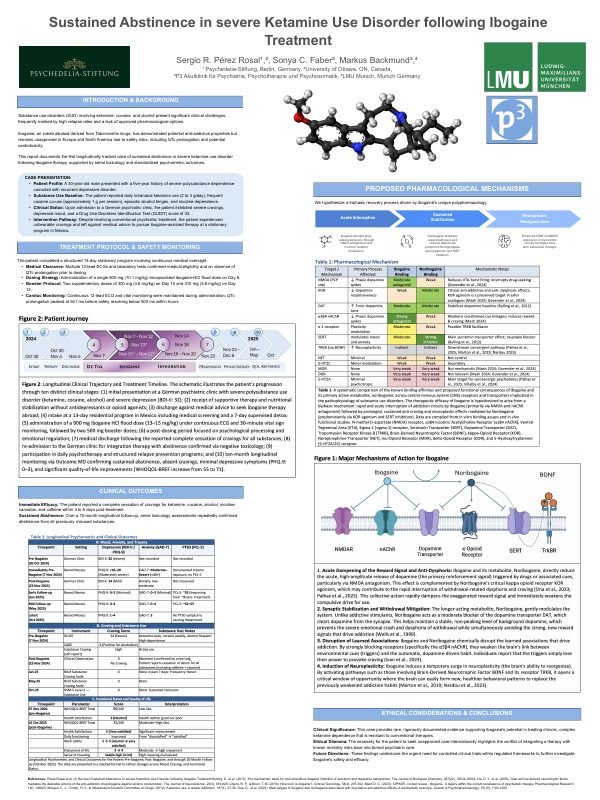
First page of the research poster “Sustained Abstinence in Severe Ketamine Use Disorder Following Ibogaine Treatment”

Sustained Abstinence in Severe Ketamine Use Disorder Following Ibogaine Treatment

Sonya Faber

Sonya Faber

PhD · Adjunct Professor

Psychedelia Stiftung, Germany

Substance use disorders involving ketamine, cocaine, and alcohol are clinically challenging, with high relapse rates and few effective pharmacological options. We report a 30-year-old man with a five-year history of severe polysubstance dependence, including daily intranasal ketamine use of 2–3 g/day, cocaine, alcohol, nicotine, and recurrent depressive disorder. Despite conventional psychiatric treatment, severe craving persisted and the patient sought medically supervised ibogaine-assisted treatment in Mexico.

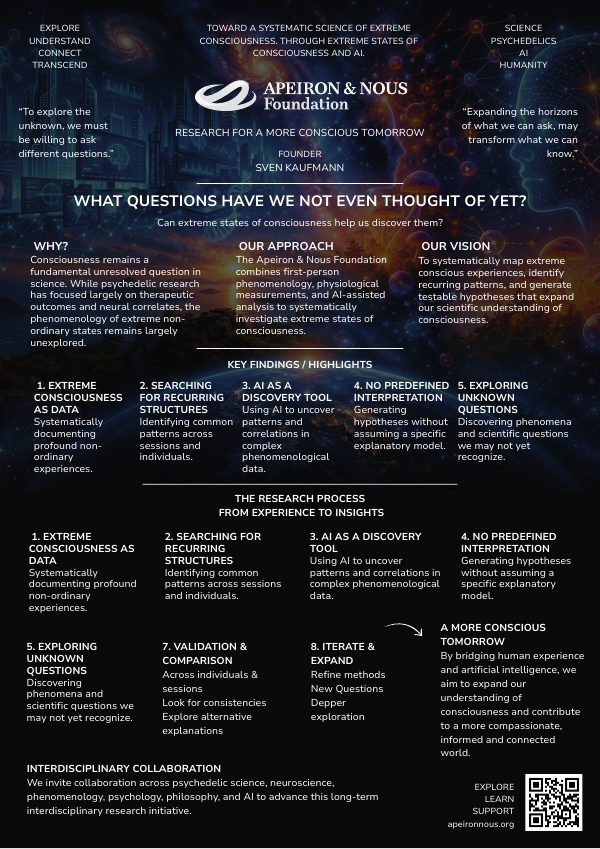
First page of the research poster “Beyond the Known: Can Extreme States of Consciousness Reveal Recurring Informational Structures?”

Beyond the Known: Can Extreme States of Consciousness Reveal Recurring Informational Structures?

Sven Kaufmann

Sven Kaufmann

Founder

Apeiron & Nous Foundation

Psychedelic science has substantially advanced our understanding of therapeutic applications and neural correlates, yet extreme psychedelic states remain comparatively unexplored. In particular, ultra-high-dose states characterized by profound ego dissolution, timelessness, experiences of the “void,” seemingly autonomous entities, and radically altered perceptions of self and reality raise fundamental questions about consciousness that have rarely been investigated systematically.

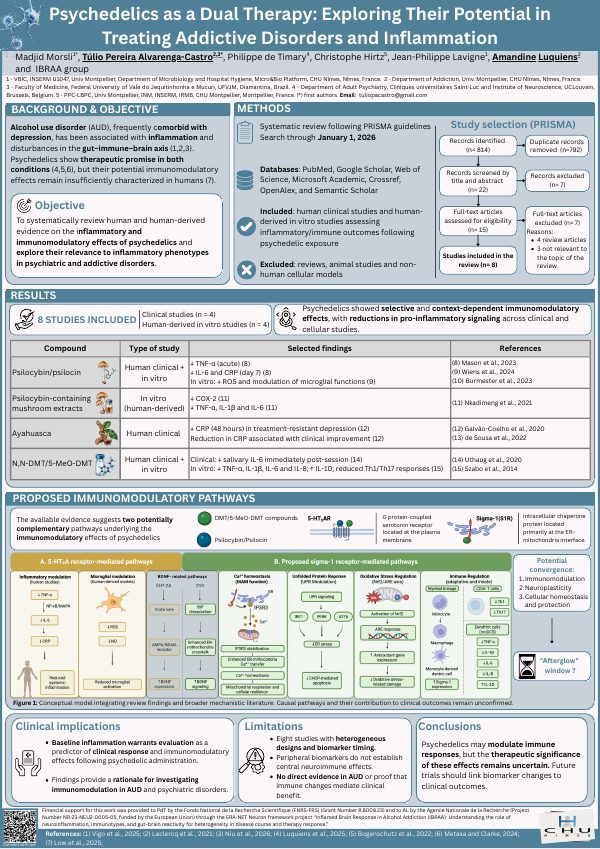
First page of the research poster “Psychedelics as a Dual Therapy: Exploring Their Potential in Treating Addictive Disorders and Inflammation”

Psychedelics as a Dual Therapy: Exploring Their Potential in Treating Addictive Disorders and Inflammation

Túlio Pereira Alvarenga-Castro

Túlio Pereira Alvarenga-Castro

MD · Physician and researcher in addictology

CHU de Nîmes, France

Background: Alcohol use disorder (AUD) and major depressive disorder are frequently associated with chronic low-grade inflammation and immune dysregulation. Psychedelic compounds have shown promising therapeutic effects across psychiatric disorders, although their immunomodulatory mechanisms remain insufficiently characterized.

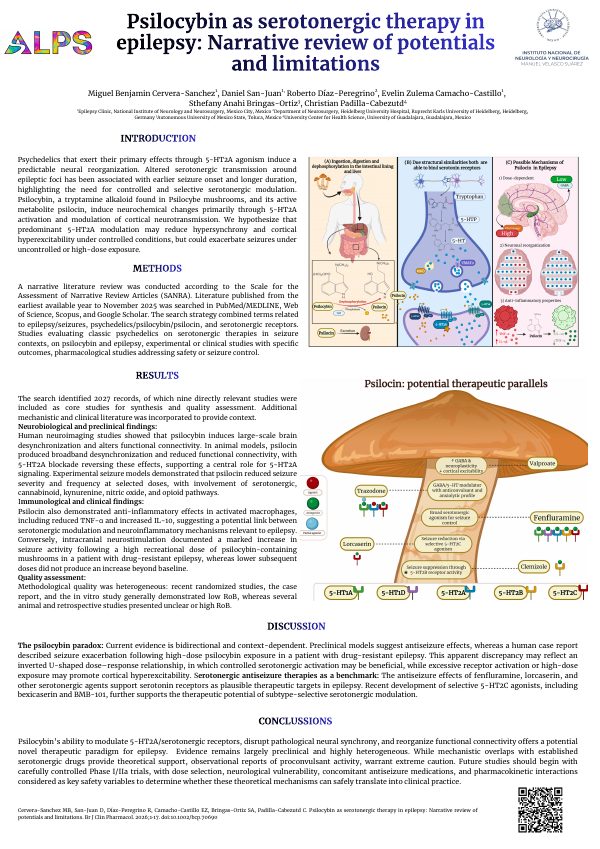
First page of the research poster “Psilocybin as Serotonergic Therapy in Epilepsy: Narrative Review of Potentials and Limitations”

Psilocybin as Serotonergic Therapy in Epilepsy: Narrative Review of Potentials and Limitations

Miguel Benjamin Cervera-Sanchez

Miguel Benjamin Cervera-Sanchez

MD · Research fellow

National Institute of Neurology and Neurosurgery “Manuel Velasco Suárez”, Mexico

Our clinical research group at the National Institute of Neurology and Neurosurgery ‘Manuel Velasco Suárez’ focuses on improving the quality of life for patients with epilepsy by exploring novel therapeutic approaches for Drug-Resistant Epilepsy. The main focus of our current work is the exploration of psilocybin, a substance historically ignored in epileptology and widely presumed to be proconvulsive.

Seeing with ‘Fresh Eyes’: Development and Validation of the Fresh Experiences Scale

Coming soon

Seeing with ‘Fresh Eyes’: Development and Validation of the Fresh Experiences Scale

Amos Lau

Amos Lau

MD

Monash University, Australia

Background: Psychedelic-assisted therapy (PAT) shows promise for a range of psychopathologies, with acute subjective effects predicting long-term therapeutic outcomes. One commonly reported but under-measured phenomenon is the experience of perceiving familiar thoughts, emotions, and experiences from a novel “child-like” perspective during acute psychedelic states.

Research poster coming soon